
Payment orchestration
Payment orchestration: what it is and how it works
The layer that decides which processor handles each transaction, retries a decline through a backup, and hands your app one consistent result.
Works with 130+ providers, including

Stripe

Worldpay

PayPal
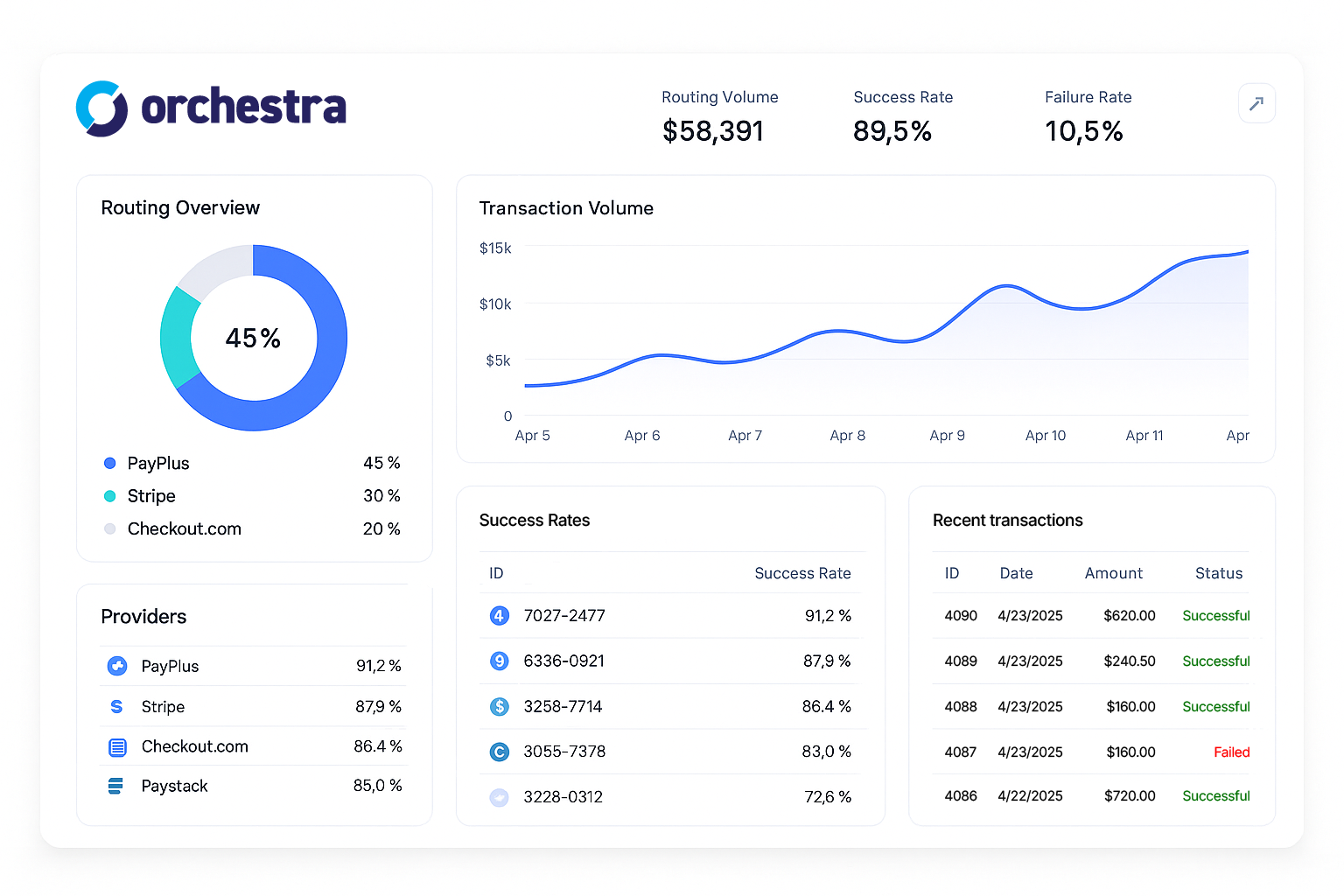
Route every payment to the right processor
Set rules on cost, approval rate, card type or geography. Orchestra makes the routing decision in under 50ms and you change the rules from a dashboard, not a deploy.
- Cost-based: cheapest PSP for the transaction type
- Geographic: EU cards to EU processors
- Performance: hard payments to high-approval PSPs
- Hybrid: combine all three
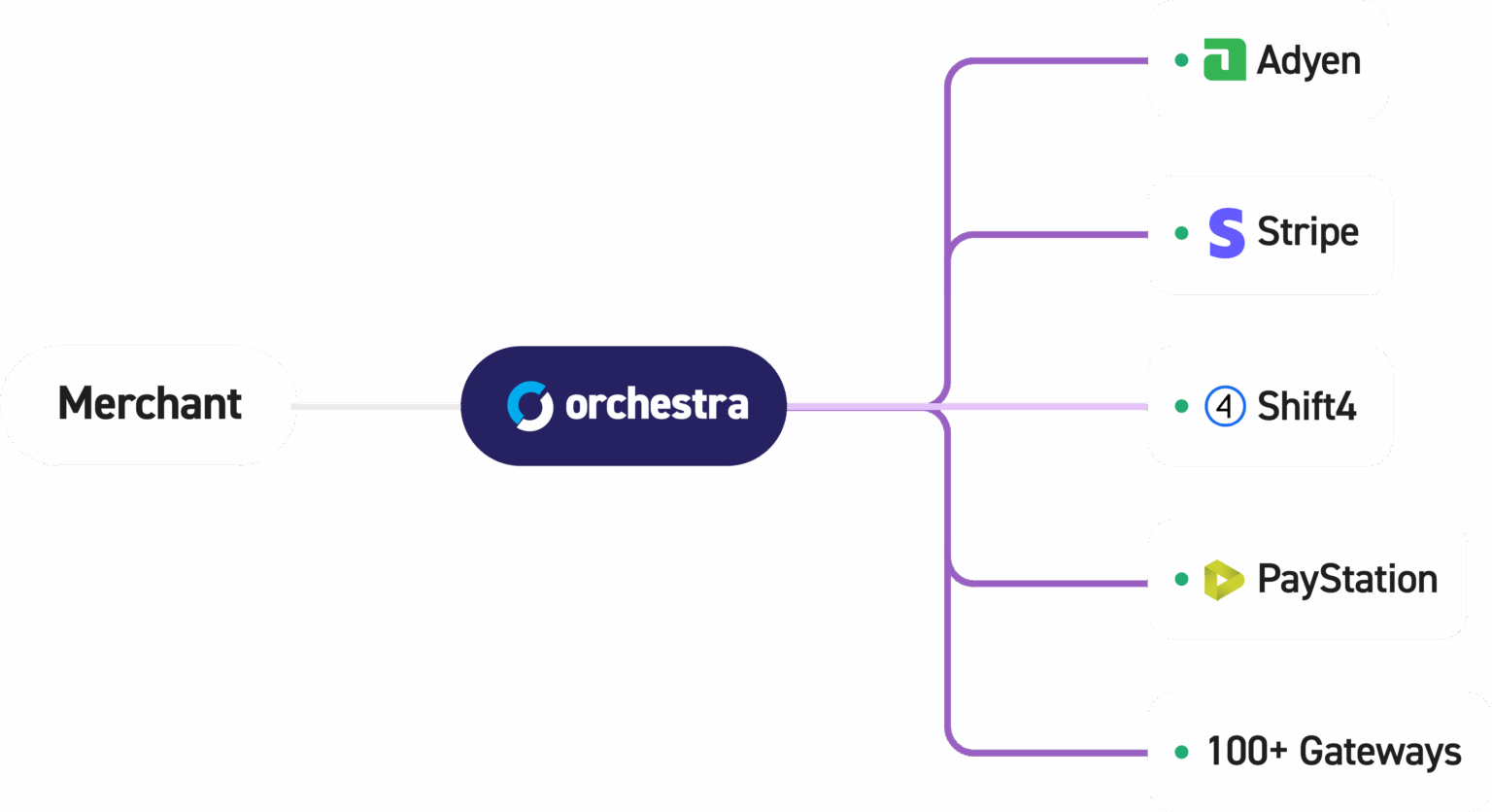
Failover
When a gateway goes down, payments keep moving
Orchestra watches transaction health across every gateway and reroutes failures in milliseconds, with no customer action.
Automatic failure detection
Real-time monitoring finds processor problems before they reach your revenue.
Instant gateway switching
A failed or timed-out transaction retries on the next processor in your list.
Configurable retry logic
Decide when failover triggers and which backup processors to try, per transaction.
Zero customer impact
Failover happens behind the scenes. The customer sees one approved payment.
Global acceptance
Every market, one integration
Every market expects different payment options. Orchestra already connects the regional methods, so you launch without a regional build.
Global methods
Apple Pay, Google Pay, Stripe, Worldpay, Adyen and more.
Regional methods
Open banking, WeChat Pay, Shift4, CCV, Rapyd and more.
Country-specific methods
UPI, PIX, PesoPay, Fat Zebra and more.
Currency flexibility
Charge in local currencies with automatic conversion.
Local authorization
Higher approval rates through regional processor relationships.
Smart method selection
Show the payment methods each customer can actually use.
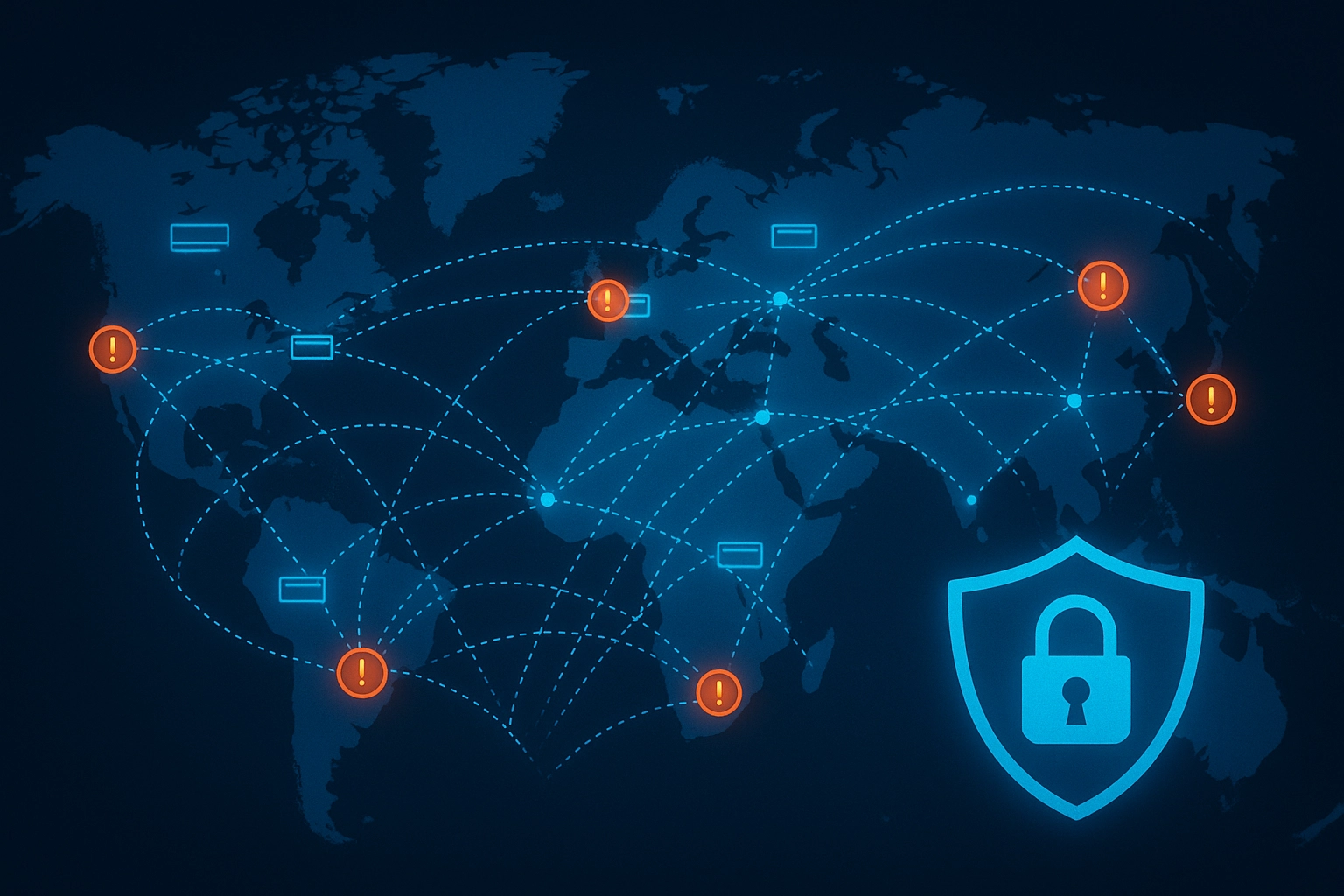
Shrink your PCI DSS scope by about 90%
Card entry runs client-side in the Orchestra Library, so cardholder data never touches your servers. Your backend charges tokens through the API and adds nothing to your scope.
SAQ D
328 requirements, before
SAQ A
31 requirements, with Orchestra
Developers
One integration, two working parts
The JavaScript Library captures payment in your checkout. The REST API drives everything after capture. Both sit on the same routing and failover layer.
const response = await fetch('https://api.orchestrasolutions.com/PaymentGateway/charge', {
  method: 'POST',
  headers: { 'X-Api-Key': 'YOUR_API_KEY' },
  body: JSON.stringify({
    payerDetails: { clientIPAddress: '1.2.3.4', countryCode: 'US' },
    PaymentGatewayAccountId: 'your_primary_psp',
    // Optional: backup processors, tried in order on a decline or timeout
    FallbackUpgs: [ 'backup_psp_1', 'backup_psp_2' ],
    currency: 'USD',
    amount: 100
  })
});
REST API
Charges on stored tokens, captures, refunds and recurring billing from your backend.
JavaScript Library
Pre-built components for cards, Apple Pay and Google Pay. Card data stays off your servers.
Open sandbox
Test immediately, no approval needed. The sandbox mirrors production.
How the routing works
A direct integration ties your revenue to one processor. An orchestration layer gives every payment a way through.
One processor
Direct integration
- A decline is a lost sale, with no retry
- An outage on your processor is an outage on your revenue
- A second processor means a second hand-built integration
- Every routing rule change is a code change and a redeploy
Orchestrated routing
With Orchestra
- A decline retries through a backup processor automatically
- An outage fails over to a working processor instead of blocking checkout
- New processors connect through the integration you already have
- Routing rules change from a dashboard, with no redeploy
Free to start • No credit card required
The measurable impact of orchestration
What changes when every transaction gets a second chance and the cheapest working processor.
What teams are saying
“During a four-hour outage at our primary processor, our customers kept processing payments through Orchestra’s backup routing.”
Engineering lead
Healthcare SaaS platform
What does orchestration change?
8-12%
higher approval rates on retried transactions
<50ms
average routing decision
~15%
lower processing cost from cost-based routing
90%
fewer PCI requirements (SAQ D to SAQ A)
What teams say about Orchestra
Healthcare SaaS
“Consolidating onto one integration cut our payment-related development overhead by about half. The team works on healthcare features again.”
Engineering lead
Practice management platform, 2,800+ clinics
eSIM provider
“During a four-hour outage at our primary processor, checkout kept running through backup routing. Travelers never noticed.”
Head of payments
Connectivity in 180+ countries
Hotel marketing company
“We offer guests 40+ local payment methods without building a single regional integration ourselves.”
Head of product
Direct booking platform for hotels
Questions and answers
Does Orchestra ever hold my funds directly?
Absolutely not; we don’t touch your funds. Your customers’ money flows directly from them to the payment gateway you used and from there to the settlement account defined with the gateway. We focus on facilitating and securing your transactions, leaving the financial handling to your payment providers.
What currencies does Orchestra support?
We support all currencies offered by the payment gateways integrated with our platform. If your gateway can handle it, Orchestra can, too. Multi-currency support has never been easier to manage.
Can Orchestra help me switch payment processors?
Of course. Whether you’re looking to replace an existing processor or add more options, Orchestra makes switching effortless. With our platform, you can test new gateways or payment methods without disrupting your current systems.
Does Orchestra support payment routing?
Yes, and it’s one of our standout features! With Orchestra, you can set up routing rules based on transaction type, currency, or even the geographic location of your customer. This flexibility allows you to optimize your payment strategy for efficiency and cost-effectiveness.
How long do new integrations take?
Most standard payment providers can be integrated within 2-4 weeks. Complex providers with unique authentication or unusual API patterns may take 4-6 weeks. We’ll give you a realistic timeline after reviewing their documentation.
What if a provider changes their API?
We monitor all integrated providers for API changes and handle updates automatically. Provider API maintenance is included in your Orchestra service – no action required from your development team.